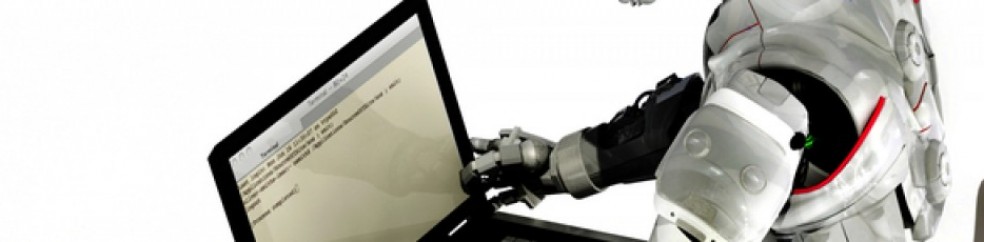

Before doing any of the reading, or even clicking on the “continue reading” button below, please write one paragraph answering the question “What is a robot?”.
Email this to me (froomkin@law.miami.edu) with the subject line ROBOTS: <insert your name here> at least 24 hours before the first class. Your paragraph will be graded pass/fail, where fail is not emailing, or not trying.
Two packets, one containing the assigned reading, and one with the optional reading, will appear in the copy shop soon. [UPDATE: See Packets Are Ready for the new plan.] I’ll post a note on this blog when they are ready. In the mean time, I’ve posted a full syllabus and some basic course info. All the readings are either available online or can be found in Robot Law (Ryan Calo et al eds 2016), a book that I’ve put on reserve in the law library.
STOP HERE (briefly) AND WRITE THAT PARAGRAPH … then page down …
Before the first class please read the following :
==UPDATE: look for other important messages on this blog
1.1 Pages 1-13 & 17-25 of Neil Richards & William Smart, How Should the Law Think About Robots? (You may skip section 3) available online at http://robots.law.miami.edu/wp-content/uploads/2012/03/RichardsSmart_HowShouldTheLawThink.pdf
1.2 § 1.3 (pp. 15-17) of EU Guidelines on Regulating Robotics (Jan. 3, 2012), full text available at http://www.robolaw.eu/RoboLaw_files/documents/robolaw_d6.2_guidelinesregulatingrobotics_20140922.pdf but due to its length I have only put the relevant pages in your packet.
1.3 Pages 525-49 of Ryan Calo, Robotics and the Lessons of Cyberlaw, 103 California Law Review 513 (2015), available online at http://papers.ssrn.com/sol3/papers.cfm?abstract_id=2402972.
1.4 §§ 5-12 (pp. 6-17) of William Smart, What do We Really Know About Robots and the Law?, (March 24, 2016) http://robots.law.miami.edu/2016/wp-content/uploads/2015/07/Smart-robots-law.pdf
Be prepared to discuss the following:
I. In your opinion, which of these are robots? Why?
A. A Roomba.
B. A machine whose sole function is to operate a grappler that tighten bolts on an assembly line.
C. A program trading software package that can make trades on the New York Stock exchange without requiring human approval.
D. A drone operating in Afghanistan remotely piloted by a person in Omaha, Neb.
E. A modern airplane that, once the destination is set by a human, not only can control the aerial portion of the flight (ie all but takeoff and landing) without further human intervention, but also in most cases retains ultimate flight control. In the normal case the plane will not permit the pilots to fly outside specified performance limits (e.g. to prevent a stall in the air). Pilots have full control only if the plane is flying under “alternate law” – an exceptional flight protocol that the plane will switch to in exceptional conditions such as if the onboard computer stops receiving sensor data about the plane’s speed and altitude. “Alternate law” gives pilots the ability to do things that ordinarily would not be permitted, including things that can crash a plane.
F. A stand-alone answering machine.
G. Voice mail.
H. An iPhone.
I. The Siri program that runs on an iPhone.
J. Google (the online search facility) .
K. Google’s self-driving car.
L. Phototropic plants.
M. A person hypnotized to repeat “I am robot” whenever anyone else shakes their hand.
N. HAL, the self-aware AI embedded in a spaceship in the movie 2001.
II. Does the definition of a robot actually matter? Why?
III. When should the law treat a robot differently from a toaster?
IV. In light of your answers to the above, does the idea of “Robot Law” make any sense? Why? And for how long?
Optional reading:
1.5 Adrienne Lafrance, What is a Robot?, The Atlantic (Mar. 22, 2016), available at http://www.theatlantic.com/technology/archive/2016/03/what-is-a-human/473166/
1.6 Sam Lehman-Wilzig, Frankenstein Unbound: Towards a Legal Definition of Artificial Intelligence, FUTURES (Dec. 1981), available online at http://profslw.com/wp-content/uploads/academic/40._Frankenstein_Unbound.Towards_a_legal_definition…pdf
1.7 Frank H. Easterbrook, Cyberspace and the Law of the Horse, 1996 U. Chi. Legal F. 207, available at http://chicagounbound.uchicago.edu/cgi/viewcontent.cgi?article=2147&context=journal_articles
1.8 Ryan Calo, Robots in American Law, http://papers.ssrn.com/abstract=2737598